Cleaning high or hard-to-reach glass can be an exhausting task, leaving many homeowners asking: are window cleaning robots worth it? These innovative automated gadgets promise crystal-clear views without the hassle, safety risks, or costly professional cleaning services. Here is why adding a smart window cleaner to your home routine might just be the ultimate time-saving upgrade.
Cleaning windows is a chore most people dread. It takes up your free time, hurts your back, and often involves dangerous ladders or risky balancing acts near high apartment windows.
Automated window cleaners promise to solve this problem. They attach to your glass and clean while you relax.
But at hundreds of dollars per unit, you need to know if they truly deliver clean glass or just waste your money. This comprehensive guide breaks down how these devices work, their real-world performance, and whether your home layout actually justifies buying one.
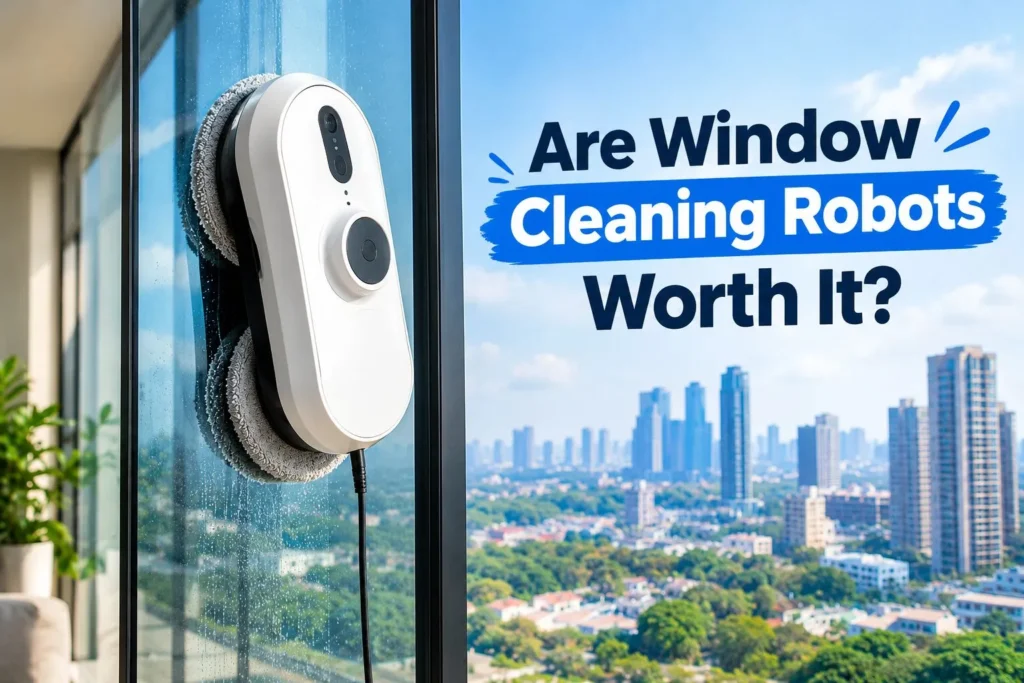
What Is a Window Cleaning Robot & Are Window Cleaning Robots Worth It?
A window cleaning robot is a smart home appliance designed to scrub vertical glass surfaces without falling.
While floor vacuums rely on wheels and gravity, window robots use advanced air tech and clever safety features to hold onto smooth glass.
The Core Technology: How They Stay Attached
Most modern window robots use a powerful motor to create strong vacuum suction.
- Vacuum Suction: High-speed motors pull air out from underneath the robot. This creates a vacuum pressure seal (often between 2,000 Pa and 3,000 Pa) that clamps the device firmly against the pane.
- Navigation Sensors: Built-in edge sensors detect window frames and frameless edges. The robot uses these signals to map the pane, moving in systematic “Z” or “N” shaped paths so it does not miss spots.
- Cleaning Mechanism: Microfiber pads sit on the underside to trap dust. Advanced models use built-in sprayers to mist water or glass cleaner directly onto the pane before wiping it clean.
The Safety System: Preventing Dangerous Falls
Because these machines operate on vertical glass, safety is the top design priority. Manufacturers build multiple safety layers into every unit to ensure the robot never drops onto the floor or passersby below.
- Backup Battery (UPS): Every corded robot has a built-in emergency battery. If someone trips on the power cord or the main power fails, this battery keeps the suction motor running for 20 to 30 minutes.
- Audio Alerts: When power drops, the machine stops moving and sounds a loud alarm so you can pick it up safely.
- Safety Rope and Carabiner: A heavy-duty rope attaches to the robot on one end and anchors to a sturdy indoor object on the other. This acts as a final safety net if all electrical systems fail.
Types of Window Cleaning Robots
Not all window cleaning robots handle glass the same way. Manufacturers build these machines in two primary shapes, each designed for specific cleaning needs and window styles.
Square vs. Dual-Disk (Round) Robots
The shape of the robot determines how well it navigates corners, scrubs spots, and covers wide glass areas.
- Square Robots: These models use a flat, square cleaning pad and track-driven rubber belts to move across the pane. Because of their straight edges, they excel at cleaning right up to the corners of rectangular frames. They cover large surfaces quickly, making them ideal for expansive floor-to-ceiling windows, sliding balcony doors, and glass facades.
- Dual-Disk (Round) Robots: These units feature two circular microfiber pads that rotate against each other to drive the robot across the glass. This spinning motion provides targeted scrubbing power, making them better at lifting light dirt film. However, because the pads are round, they cannot reach deep into sharp 90-degree window corners.
| Feature | Square Robots | Dual-Disk (Round) Robots |
| Best For | Large, rectangular glass panels | Medium windows and light spot scrubbing |
| Corner Reach | Excellent edge and corner coverage | Leaves small uncleaned spots in corners |
| Cleaning Speed | Fast, systematic Z/N paths | Slower, rotating motion |
| Movement Type | Rubber tracks | Alternating spinning pads |
Corded vs. Cordless Models
Power source plays a major role in both convenience and safety.
- Corded Models (Most Common): Almost all top-rated window robots run on continuous mains electricity through a long power cable. Constant power ensures the motor maintains maximum suction pressure without fading midway through a job.
- Cordless Models: Battery-powered options offer complete freedom from extension cords, making them easier to set up outdoors. However, they are heavier due to large internal batteries, carry shorter runtimes (usually 30–50 minutes), and require strict monitoring so the battery does not run out high above the ground.
Key Benefits: Where Window Cleaning Robots Shine
For homes with the right architectural setup, automatic window cleaners offer clear advantages that save time and reduce hassle.
1. Complete Elimination of Physical Risks
Leaning out of high apartment windows or balancing on top steps of tall ladders causes thousands of home injuries every year.
A window robot handles high, exterior, or hard-to-reach glass while your feet stay firmly on the ground. You simply attach the safety tether, lock the machine onto the pane, and start it.
2. Significant Time Savings for Large Glass Setups
If your home features wide sliding doors, glass balcony railings, or floor-to-ceiling facades (check this on YouTube), cleaning them manually takes hours of tedious wiping and drying. A robot automates routine maintenance. While it cleans one pane, you can focus on other household tasks, work, or relax.
3. Accessibility for Seniors and People with Mobility Limits
Manual window washing requires stretching, bending, and continuous arm strength. For elderly homeowners or individuals with back, shoulder, or joint pain, maintaining clear glass can become nearly impossible. A robot removes this physical strain entirely.
4. Multi-Surface Versatility
Window robots are not limited to exterior glass. You can use them indoors on a variety of smooth, flat surfaces:
- Frameless shower glass doors
- Large mirrored walls and wardrobe doors
- Smooth, high-gloss bathroom wall tiles
- Glass room dividers and office partitions
Drawbacks and Limitations: What Manufacturers Don’t Tell You
While window cleaning robots offer great convenience, aggressive marketing can set unrealistic expectations. Knowing these limitations helps you avoid buyer’s remorse.
1. They Cannot Handle Heavy Grime or Mud
Window robots are designed for routine maintenance, not heavy restoration. If your glass has baked-on bird droppings, thick sea-salt crust, or months of dried mud, a robot will simply smear the dirt around. To get good results, you must manually spray and wipe extremely dirty windows before letting the robot take over for regular upkeep.
2. You Must Move Them Pane by Pane
Unlike robotic floor vacuums, window cleaners cannot travel from room to room automatically. They cannot cross window frames, grilles, or handles. Every time the robot finishes a single glass section, it stops and beeps. You must physically move it to the next pane, anchor the safety rope, and press start all over again.
3. Corners and Frame Edges Get Missed
No robot leaves a 100% perfect edge.
- Round models miss the sharp corners of rectangular frames due to their circular pads.
- Square models get close to corners, but their rubber tracks and edge-detection bumper sensors prevent them from pressing flush against frame edges.
You should expect to manually touch up small border strips on occasion.
4. Noise Levels and Cleaning Speed
Window robots rely on high-RPM suction motors, making them as loud as a standard canister vacuum (typically 65 dB to 75 dB). Additionally, they move deliberately and slowly to ensure a safe hold and proper wipe. Cleaning a set of large patio doors can take 20 to 30 minutes.
Cost Analysis & ROI Breakdown
Understanding price tiers and potential savings helps you calculate if a window cleaning robot fits your household budget.
Price Tiers: What to Expect
- Entry-Level ($100 – $200): Basic suction power, remote control operation, simple Z-path navigation, and manual water spraying. Best for small, single-story homes.
- Mid-Range ($200 – $400): Higher suction pressure, smart app control, automatic dual-direction water spray nozzles, and better edge detection for frameless glass.
- Premium Models ($400+): Ultrasonic spray technology, ultra-slim profiles for tight window grilles, advanced obstacle avoidance, and faster cleaning speeds.
Robot Purchase vs. Professional Cleaning Services
Hiring professional window cleaners typically costs between $150 and $300 per visit, depending on your home’s size and story height. If you hire professionals twice a year:
- Professional Service (Year 1): $300 – $600
- Mid-Range Robot (One-Time Cost): ~$300
A quality mid-range window robot pays for itself within 6 to 12 months. After that break-even point, your routine window maintenance is essentially free, saving you hundreds of dollars every year.
How to Get the Best Results from Your Robot (Step-by-Step)
To get streak-free, crystal-clear glass without damaging your machine, follow this simple three-step cleaning routine.
Step 1: The Dry Wipe Pass (Removing Loose Dust)
Never start with a wet cleaning pad if your exterior windows are covered in heavy dust, sand, or pollen. Applying liquid right away turns dry dust into muddy streaks.
- Attach a fresh, dry microfiber pad to the robot.
- Run a standard cleaning cycle without spraying any water or glass cleaner.
- This pass sweeps away loose particles so they do not scratch the glass during the wet cycle.
Step 2: The Wet Cleaning Pass (Removing Smudges and Stains)
Once the surface dust is gone, you can target smudges, fingerprints, and light grime.
- Swap the dirty pads for clean, dry microfiber pads.
- Lightly mist the pad edges with dedicated glass cleaner, or activate the robot’s automatic spray function. Do not soak the pads; overly wet pads cause the rubber tracks to slip and leave liquid streaks.
- Run the robot on a deep-clean or “Z/N” double-pass cycle.
Step 3: Frame and Pad Maintenance
Proper maintenance keeps your robot operating safely and extends pad lifespan.
- Wash pads immediately: Wash microfiber pads in warm water right after use to prevent dirt from hardening into the fabric. Avoid fabric softeners, as they reduce pad absorbency.
- Clean the tracks and sensors: Wipe the rubber drive tracks and optical edge sensors with a damp cloth after every use to maintain traction and navigation accuracy.
Frequently Asked Questions (FAQ)
Do window cleaning robots fall off easily?
No. Quality models feature strong vacuum motors (2,000+ Pa) that keep them firmly attached to smooth glass. In case of a power outage, the internal backup battery (UPS) holds suction for up to 30 minutes while sounding an alarm, and the heavy-duty safety tether provides a reliable physical safety net.
Can you use regular glass cleaner in a window robot?
Yes, but check your user manual first. Most models work well with standard glass cleaners or plain distilled water. Avoid thick, soapy liquids or heavy waxes, which can clog automatic spray nozzles and cause drive tracks to slip.
Do window robots work on double-glazed or tint-coated glass?
Yes. Suction-based window robots work on double-glazed glass, solar-tinted glass, and frosted film, provided the surface is smooth and flat. Magnetic-based models, however, may struggle on thick double-glazed units.
How long do backup batteries last during a power outage?
The internal Emergency Power System (UPS) battery usually lasts between 20 and 30 minutes. This gives you plenty of time to safely unclip the safety rope and retrieve the device.
Final Verdict
Window cleaning robots are far from an unnecessary gimmick, but they are not a universal solution for every home either. Their real value depends entirely on your home’s layout, window architecture, and safety needs.
If you live in a high-rise apartment, manage expansive floor-to-ceiling glass, or find physical window washing dangerous and exhausting, a window cleaning robot is easily worth the investment.
It eliminates high-altitude risks, automates routine upkeep, and quickly pays for itself compared to hiring commercial cleaning services.
However, if your home features small, multi-pane windows, external security bars, or heavy grime that accumulates over years, traditional squeegees remain faster and more effective.
By understanding their limits—such as manual relocation between frames and pre-wiping heavy mud—you can set realistic expectations.
For the right architectural setup, an automatic window cleaner turns one of the most tedious, hazardous household chores into an effortless, press-and-forget routine.
Now, after reading this detailed article, you have the answer to your question: Are window cleaning robots worth it?
People Also Read: